
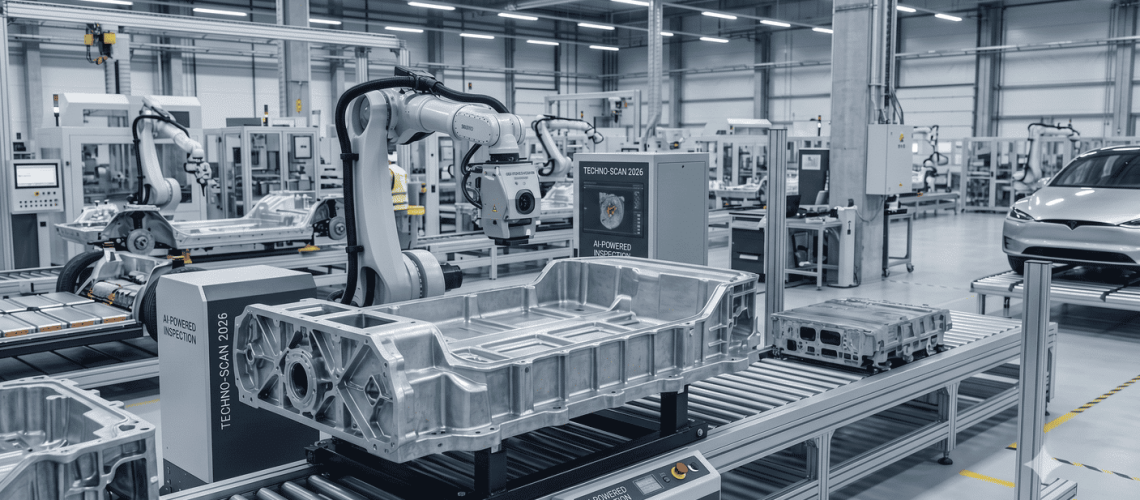
As electric vehicle production accelerates in 2026, aluminum die castings have become the backbone of modern lightweighting strategies. But beneath the surface of every battery housing, motor enclosure, and structural subframe lies a hidden threat that can compromise part integrity: porosity. For OEM procurement teams and Tier-1 suppliers, understanding how porosity forms—and how leading foundries eliminate it—is now a critical sourcing competency.
The EV Lightweighting Boom: Aluminum Demand at Record Levels
The automotive parts aluminum and magnesium die casting market is projected to grow at a CAGR of 6.5% from 2026 to 2034, reaching $74.8 billion by 2034 (up from $42.6 billion in 2025). Pressure die casting alone holds a 58.4% share of this market, with Asia Pacific commanding 47.2% of regional revenue.
Several forces are driving this surge:
- Range anxiety: Every kilogram saved translates directly into additional driving range, making aluminum the material of choice for EV platforms
- Mega-castings: OEMs like Tesla, Volvo, and Hyundai are adopting large-format integrated die castings—replacing dozens of stamped and welded steel parts with single aluminum castings
- Regulatory pressure: Euro 7 emissions standards and US CAFE mandates are pushing automakers to reduce vehicle mass across all segments
- Battery enclosures: EV battery housings demand complex, thin-walled, pressure-tight aluminum castings with zero-defect sealing surfaces
According to DuckerFrontier research, total aluminum content in North American light vehicles is expected to reach 514 pounds per vehicle by 2026—a 12% increase from 2020 levels. Aluminum hood adoption is projected to hit 81%, with door penetration reaching 30%. For EVs specifically, the growth in extrusions and high-pressure die cast parts is even steeper due to battery housings, motor enclosures, and structural body components.
Porosity: The Hidden Defect That Can Derail Your Supply Chain
As casting geometries become larger, thinner, and more complex to meet EV demands, the risk of porosity defects increases significantly. Porosity is the presence of voids, bubbles, or cavities within a casting—and it remains the single most common quality challenge in aluminum die casting.
Three Types of Porosity Every Buyer Should Know
1. Gas Porosity – Caused by trapped air or hydrogen gas dissolved in molten aluminum. These voids are typically round, smooth-walled, and often grouped together. Gas porosity is buoyant and tends to accumulate near the top of the casting.
2. Shrinkage Porosity – A solidification defect that occurs as aluminum contracts during cooling. Unlike gas porosity, shrinkage voids have rough, irregular, jagged appearances. They form in the last areas to solidify and can severely weaken structural components.
3. Reaction Porosity – Caused by chemical reactions between molten aluminum and mold materials, core binders, or coatings. This type is always localized and surface-level, often appearing as a “halo” around sand cores.
Why Porosity Matters More for EV Components
In traditional ICE vehicle applications, a small internal void in a non-critical area may not carry significant risk. But EV components operate under different demands:
- Battery housings require pressure-tight seals to prevent coolant or moisture ingress—porosity on a sealing face can cause catastrophic failure
- Structural mega-castings (shock towers, subframes) must absorb crash energy predictably—internal voids alter deformation behavior
- Motor enclosures operate under continuous thermal cycling—porosity can propagate into cracks under repeated stress
- Machined surfaces on transmission housings or mounting faces expose hidden porosity during CNC operations, causing cosmetic rejects and assembly leaks
How Advanced Foundries Control Porosity: A Multi-Layer Approach
Industry leaders have moved far beyond simple visual inspection. The most effective porosity control strategies address the problem at every stage of production:
Stage 1: Design & Simulation
- Mold flow simulation (e.g., MAGMA, AnyCasting) to predict filling patterns, air entrapment zones, and hot spots before tooling is cut
- DFM (Design for Manufacturability) reviews that optimize wall thickness transitions, gating geometry, and venting placement
- Alloy selection matched to application—A380 for general purpose, A356-T6 for structural/heat-treated parts, ADC12 for high-volume Asian OEM specifications
Stage 2: Process Control
- Vacuum-assisted die casting to evacuate air from the cavity before injection—one study showed an 87% reduction in porosity-related defects using this method
- Optimized injection profiles with multi-stage slow-shot and fast-shot parameters to minimize turbulence
- Real-time shot monitoring systems that track pressure curves and flag deviations before parts leave the machine
- Hydrogen degassing of molten aluminum using rotary degassers with argon or nitrogen to reduce dissolved hydrogen below 0.15 ml/100g
Stage 3: Inspection & Verification
- X-ray radiographic inspection (NDT) to detect internal porosity without destroying the part—essential for safety-critical EV structural components
- Optical emission spectrometry (OES) to verify alloy composition and detect trace elements that affect fluidity and solidification behavior
- Coordinate measuring machines (CMM) for dimensional verification of critical features after machining
- Pressure and leak testing for components requiring fluid-tight or gas-tight performance
New Standards Raising the Bar: EN 573-3:2026
In March 2026, the European standard EN 573-3:2026 was published, representing a landmark upgrade for aluminum alloy chemical composition specifications. This revision harmonizes requirements globally, introduces new alloy designations for advanced applications (including EV-specific grades), and tightens trace element limits that directly affect casting quality.
For procurement teams, this means:
- Updated material certificates and compliance documentation are required
- Suppliers must demonstrate traceability from ingot to finished casting
- Quality labs need current spectrometer calibration libraries aligned with the new standard
- Cross-border supply chains benefit from harmonized specifications, reducing disputes over material compliance
Foundries that have already aligned their quality systems with EN 573-3:2026—alongside existing IATF 16949 and ISO 9001:2015 certifications—are positioned to serve the most demanding global OEM programs without additional audit burden.
Selecting a Die Casting Partner: A Quality-First Checklist
For OEM and Tier-1 procurement teams evaluating aluminum die casting suppliers for EV programs, the following criteria separate capable partners from risky ones:
- ✅ Performs mold flow simulation and DFM review before tooling commitment
- ✅ Operates vacuum-assisted die casting systems for structural components
- ✅ Maintains in-house X-ray NDT capability for internal defect detection
- ✅ Uses optical emission spectrometry (OES) for real-time alloy verification
- ✅ Operates a temperature-controlled metrology lab with CMM and vision measurement systems
- ✅ Holds IATF 16949 certification (automotive quality management) in addition to ISO 9001:2015
- ✅ Provides full dimensional reports, material certificates, and X-ray records with each shipment
- ✅ Has in-house CNC machining capability to control porosity exposure during secondary operations
- ✅ Offers multiple casting processes (die casting, gravity casting, sand casting, investment casting) to match each part to the optimal method
- ✅ Demonstrates production capacity aligned with your volume requirements (prototype through mass production)
Renyi Castings: 20 Years of Precision, Built for the EV Era
Founded in 2005 in Ningbo, China, Renyi Castings has spent two decades building the quality infrastructure that today’s EV supply chain demands. With 60 employees and a monthly output exceeding 150,000 castings, we serve automotive, aerospace, medical, industrial, LED, telecom, and energy markets worldwide.
Our quality-first approach includes:
- Six core processes: Aluminum die casting, gravity casting, sand casting, investment casting, precision forging, and large heavy-duty components—allowing each part to be matched to the optimal manufacturing method
- In-house tooling: Mold design and manufacturing under one roof, with simulation-driven DFM from day one
- Complete post-casting services: CNC machining (3-axis through 5-axis) and surface treatment, eliminating porosity exposure risks from outsourced secondary operations
- 20°C controlled metrology lab: Equipped with Hitachi OES spectrometer, 8kW X-ray NDT system, CMM, vision measurement system (VMS), and 100kN universal material tester
- Certified quality systems: ISO 9001:2015 and IATF 16949 certified, with full PPAP, APQP, and SPC documentation capabilities
Whether you need 500 prototype castings for design validation or 150,000 units per month for a production EV program, Renyi delivers consistent quality with the documentation trail your quality team requires.
Take the Next Step
If your team is sourcing aluminum castings for EV platforms, structural components, or precision industrial applications, start a conversation with our engineering team. Send us your 2D drawings or 3D CAD models, and we’ll provide a DFM review, porosity risk assessment, and competitive quotation within 48 hours.