
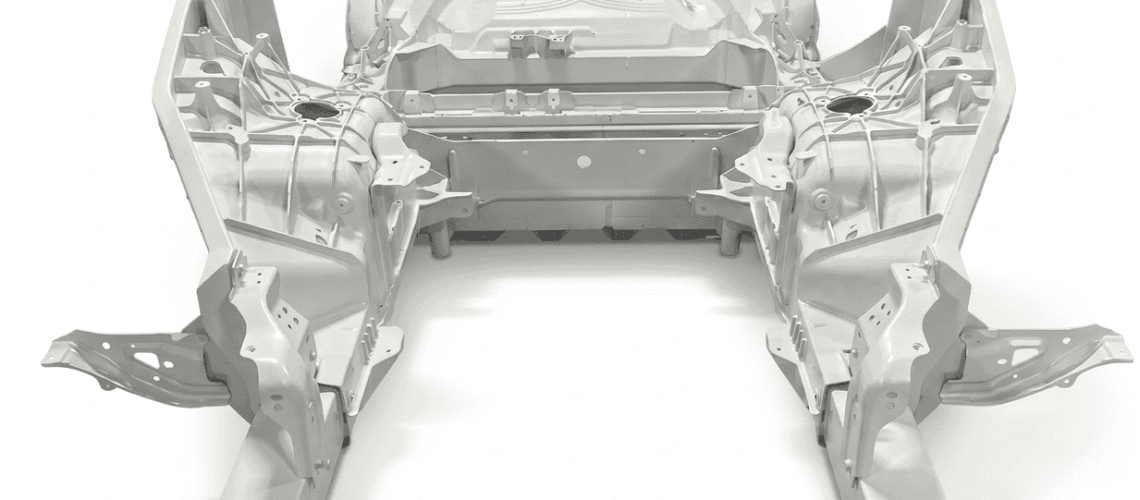
The electric vehicle revolution is rewriting the rules of metal casting. As OEMs race to consolidate hundreds of stamped and welded components into single-piece aluminum structures, the pressure on foundries has never been greater. Gigacasting — the process of producing massive, integrated aluminum castings for EV underbodies, battery trays, and structural components — is projected to grow from USD 1.30 billion in 2025 to USD 4.27 billion by 2035, at a CAGR of 12.63%. Meanwhile, the broader EV aluminum die casting parts market is forecast to reach USD 45.3 billion by 2034.
But bigger castings mean bigger risks. As wall sections grow thicker and geometries become more complex, defect prevention becomes exponentially harder. For procurement managers and design engineers sourcing EV components, understanding the intersection of lightweighting trends, gigacasting challenges, and quality certification frameworks is essential to avoiding costly supply chain failures.
The Lightweighting Imperative: Every Kilogram Counts
Electric vehicles are inherently heavier than their ICE counterparts — battery packs alone can add 300–500 kg to curb weight. That extra mass directly erodes range: every 10% reduction in vehicle weight improves EV range by 6–8%. This arithmetic makes lightweighting a core engineering mandate, not just a nice-to-have.
Aluminum die casting delivers components that are 40–60% lighter than steel equivalents while maintaining structural integrity. Advanced alloys — including high-silicon and aluminum-silicon-copper compositions — now enable thinner walls, larger parts, and more intricate geometries than were possible even five years ago. Magnesium alloys are also gaining ground, offering superior fluidity and even lower density for non-structural applications.
The result: OEMs are redesigning entire vehicle platforms around aluminum castings, replacing dozens of welded stampings with a single integrated component.
Gigacasting: Promise and Pitfalls
Gigacasting — pioneered by Tesla and now adopted by Toyota, Volvo, Hyundai, and others — uses high-pressure die casting machines rated at 6,000 to 16,000 tons to produce entire rear underbodies, front underbodies, or battery trays as single pieces. The advantages are compelling:
- Part count reduction from 70+ welded components to a single casting
- Elimination of welding jigs, robots, and associated quality checks
- Weight savings of 10–20% on structural assemblies
- Faster assembly line throughput and lower capital expenditure per unit
However, the challenges are equally significant. Setting up a gigacasting cell costs over USD 62 million, with 12–18 months before ROI. More critically, current aluminum alloys develop approximately 15% porosity when cast into sections thicker than 120 mm — a serious concern for structural components that must meet crash-safety standards.
For the vast majority of OEMs and Tier-1 suppliers who are not yet ready for full gigacasting, the practical path forward involves medium-scale part consolidation — combining 5 to 15 components into larger integrated castings using conventional high-pressure die casting (HPDC), gravity casting, or investment casting processes. This approach delivers 80% of the weight and cost benefits at a fraction of the capital investment.
The Defect Landscape: What Goes Wrong in Large Aluminum Castings
As casting size and complexity increase, so does the defect surface area. The most critical quality risks in large-format aluminum castings include:
Porosity
Gas porosity and shrinkage porosity remain the number-one defect in aluminum die casting. In thicker sections common to structural EV components, trapped hydrogen gas and solidification shrinkage create internal voids that compromise fatigue strength and pressure tightness. Causes include inadequate degassing, improper gating design, insufficient intensification pressure, and poor thermal management of the die.
Cold Shuts and Misruns
When molten aluminum flows meet but fail to fuse — or fail to fill the cavity entirely — the result is a cold shut or misrun. These defects are especially prevalent in large, thin-walled castings where flow distances are long and temperature gradients are steep. Simulation-driven gating design and precise thermal control are essential countermeasures.
Hot Tears
Hot tearing occurs during solidification when thermal contraction is constrained by the die geometry, creating cracks at stress-concentration points. Large castings with complex rib structures are particularly vulnerable. Alloy selection (especially iron content between 0.8% and 1.1%), optimized draft angles, and controlled cooling rates are critical preventive measures.
Dimensional Inaccuracy
Larger castings are more prone to warpage and dimensional drift due to uneven cooling and residual stresses. For EV structural components that must interface precisely with battery modules, suspension mounts, and body-in-white structures, even small deviations can cascade into assembly-line stoppages.
Your Casting Supplier Checklist for 2026 EV Programs
When evaluating aluminum casting partners for EV lightweighting and part consolidation projects, procurement teams should verify the following capabilities:
- ✅ Supplies FAI and CMM dimensional reports with material certificates for every batch
- ✅ Performs mold flow analysis and DFM (Design for Manufacturability) before tooling commitment
- ✅ In-house mold design and manufacturing to control lead time and iterate rapidly
- ✅ Multiple casting processes (HPDC, gravity, sand, investment) to match alloy and geometry requirements
- ✅ Advanced NDT capabilities including X-ray inspection for internal porosity detection
- ✅ In-house CNC machining with CMM verification for critical dimensions
- ✅ OES spectrometer for real-time alloy composition verification
- ✅ Climate-controlled metrology lab for precision measurement at stable temperature
- ✅ Proven track record with automotive OEMs and Tier-1 suppliers
- ✅ Scalable production capacity (100K+ units/month) for high-volume EV programs
How Renyi Castings Meets the Challenge
Founded in 2005 in Ningbo, China, Renyi Castings has spent two decades building the integrated capabilities that today’s EV supply chain demands. With ISO 9001:2015 certification, a 60-person team, and monthly production exceeding 150,000 castings, Renyi operates as a true one-stop casting partner for automotive, aerospace, medical, and industrial OEMs worldwide.
Six core processes under one roof: aluminum die casting (HPDC), aluminum gravity casting, sand casting, investment casting, precision forging, and large heavy-duty component casting. This process diversity means Renyi can match the optimal method to each component’s geometry, volume, and performance requirements — whether it is a thin-walled EV motor housing or a heavy-duty structural bracket.
In-house vertical integration: mold design and manufacturing, CNC machining, and surface treatment are all performed on-site, eliminating handoff delays and quality gaps between subcontractors.
Metrology and quality assurance: a 20°C climate-controlled metrology lab houses a Hitachi OES spectrometer for alloy verification, an 8kW X-ray NDT system for internal defect detection, CMM and VMS for dimensional inspection, and a 100kN universal material tester for mechanical property validation. Every critical parameter is measured, documented, and traceable.
Looking Ahead
The convergence of gigacasting adoption, advanced alloy development, and tightening OEM quality standards is creating a pivotal moment for the aluminum casting industry. Foundries that invest in simulation-driven process design, integrated quality systems, and multi-process flexibility will capture the lion’s share of the growing EV component market. Those that rely on legacy methods and end-of-line inspection alone will struggle to keep pace.
For OEM procurement teams and design engineers, the message is clear: the partner you choose for your next EV casting program must bring more than capacity. They need certified quality systems, advanced inspection infrastructure, and the engineering depth to solve problems before they reach your assembly line.
Get in touch with Renyi Castings to discuss your next aluminum casting project — from DFM review through production launch.