
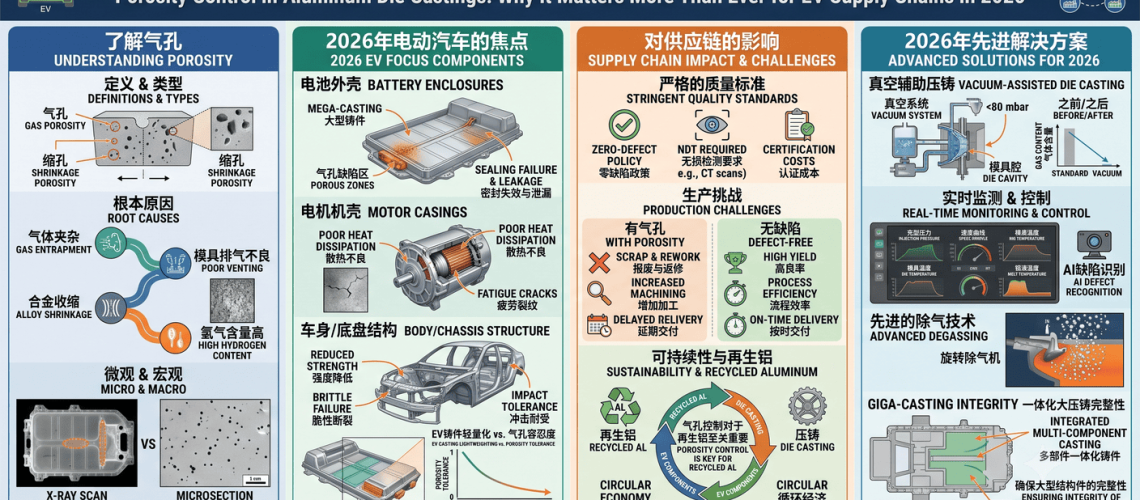
The automotive metal die casting market reached $28.6 billion in 2025 and is projected to hit $47.3 billion by 2034, growing at a 5.8% CAGR. Meanwhile, the EV lightweight materials market is expanding at a staggering 27% CAGR, expected to reach $35.73 billion by 2030. As electric vehicle production accelerates globally, aluminum die castings have become the backbone of modern vehicle lightweighting — but one persistent defect threatens to undermine the entire supply chain: porosity.
For OEM procurement engineers and quality managers sourcing aluminum castings from China, understanding porosity — its types, root causes, detection methods, and prevention strategies — is no longer optional. With OEM audit requirements tightening and ISO 9001:2026 on the horizon, the quality bar for casting suppliers has never been higher.
The EV Lightweighting Imperative: Why Aluminum Casting Demand Is Surging
Every 10% reduction in vehicle weight improves EV range by 6–8% through lower energy consumption. This direct relationship makes lightweighting essential for consumer adoption and regulatory compliance. Aluminum die cast components are 40–60% lighter than steel equivalents while maintaining structural integrity — making them the preferred solution for:
- Battery enclosures and housings (up to 100 kg per vehicle)
- E-motor housings and thermal management systems
- Structural body-in-white components
- Transmission and powertrain housings
- Suspension and chassis components
Aluminum content per vehicle is expected to reach 556 pounds by 2030, with castings remaining the largest product form. The vacuum die casting segment — critical for producing porosity-free structural EV parts — is the fastest-growing production process at a 7.6% CAGR through 2034. This growth underscores a fundamental truth: the EV revolution depends on defect-free aluminum castings.
Understanding Porosity: The #1 Defect in Aluminum Die Castings
Porosity refers to voids, holes, or air pockets trapped within a casting. It is the most common — and most expensive — defect in high-pressure aluminum die casting. Porosity compromises structural integrity, pressure tightness, and surface finish quality, leading to part rejection, warranty claims, and in worst cases, field failures.
Two Primary Types of Porosity
1. Gas Porosity
- Caused by trapped air, moisture, or hydrogen gas during injection
- Appears as smooth, round voids distributed throughout the casting
- Often concentrated near gates, runners, and thick sections
- Primary sources: inadequate venting, turbulent filling, contaminated melt, or insufficient degassing
2. Shrinkage Porosity
- Caused by volumetric contraction as molten aluminum solidifies
- Appears as irregular, jagged voids often connected in networks
- Typically found in thick sections, hot spots, and last-to-freeze zones
- Primary sources: improper cooling rates, inadequate feeding, or poor thermal management in the die
Three Classifications by Exposure
- Blind porosity — Open to one surface; causes internal corrosion and surface defects during powder coating or anodizing
- Through porosity — Connects two surfaces; destroys pressure tightness and structural integrity
- Fully enclosed porosity — Hidden internally; becomes problematic when secondary CNC machining exposes the void
The Six-Point Porosity Prevention Framework
Eliminating porosity requires a systematic, multi-layered approach. Leading foundries implement the following framework:
1. Mold Flow Simulation and DFM
Before tooling is cut, casting simulation software (such as MAGMA, ProCAST, or AnyCasting) models the entire filling and solidification process. This identifies potential porosity hot spots, optimizes gate and runner design, and validates cooling channel placement. Design for Manufacturability (DFM) reviews ensure wall thickness transitions, fillet radii, and rib placement minimize shrinkage risk.
2. Optimized Mold Venting and Vacuum Systems
Proper venting allows trapped air to escape during cavity filling. For critical structural components — especially EV battery housings and safety parts — vacuum-assisted die casting evacuates the cavity before injection, reducing gas porosity to near-zero levels. The vacuum die casting segment’s 7.6% CAGR reflects growing OEM demand for this technology.
3. Precise Injection Parameter Control
Injection speed, pressure, and switch-over point directly influence turbulence and air entrapment. Slow shot speeds in the initial phase prevent air mixing; controlled fast shot ensures complete cavity fill; and intensification pressure compresses any remaining gas bubbles. Modern die casting machines with real-time closed-loop control maintain consistency across thousands of shots.
4. Melt Quality and Degassing
Hydrogen is the primary gas dissolved in molten aluminum. Rotary degassing with inert gas (argon or nitrogen) reduces hydrogen content to below 0.15 ml/100g before pouring. Spectral analysis via OES (Optical Emission Spectrometry) verifies alloy composition and detects contamination in real time, ensuring every batch meets specification before it reaches the die casting machine.
5. Thermal Management
Die temperature directly affects solidification patterns and shrinkage behavior. Thermal imbalance creates hot spots where shrinkage porosity concentrates. Advanced foundries use die thermal imaging, segmented cooling circuits, and thermocouple arrays to maintain uniform die temperature within ±5°C across the entire cavity surface.
6. Non-Destructive Testing (NDT) and Verification
Even with perfect process control, verification is mandatory for safety-critical and pressure-tight components. The industry is moving beyond legacy methods (ultrasound, fluoroscopy) toward advanced X-ray and industrial CT scanning that precisely characterizes each void’s shape, size, and location in 3D. This enables:
- Early porosity detection to minimize scrap and rework
- Automated 3D analysis of pore distribution and volume
- Root cause tracing back to gating, cooling, or shot parameters
- Faster product qualification and first-article approval
Supply Chain Implications: What OEM Buyers Should Demand
When evaluating aluminum casting suppliers for EV and automotive programs, the following capabilities separate reliable partners from risky vendors:
- ✅ Performs mold flow simulation and DFM review before tooling commitment
- ✅ Operates vacuum-assisted die casting for structural and pressure-tight components
- ✅ Maintains in-house melt degassing with real-time OES spectral analysis
- ✅ Uses closed-loop injection parameter control with shot-by-shot monitoring
- ✅ Employs X-ray NDT for internal porosity inspection on critical parts
- ✅ Holds ISO 9001:2015 certification with current audit records
- ✅ Maintains a temperature-controlled metrology lab (20°C ±1°C) with calibrated CMM and measurement instruments
- ✅ Provides complete inspection documentation: FAI and CMM dimensional reports, OES material certificates and X-ray records
- ✅ Offers in-house CNC machining and surface treatment to minimize secondary handling damage
- ✅ Demonstrates traceability from raw material certification through finished part inspection
How Renyi Castings Delivers Porosity-Free Confidence
Founded in 2005 in Ningbo, China, Renyi Castings has spent two decades building the exact capabilities that modern EV and automotive programs demand. With 60 employees producing over 150,000 castings per month across six core processes — aluminum die casting, gravity casting, sand casting, investment casting, precision forging, and large heavy-duty components — the company combines scale with precision.
Porosity prevention at Renyi Castings is engineered into every step:
- In-house mold design and manufacturing — Enables mold flow simulation, optimized gating, and rapid tooling iteration before production begins
- Hitachi OES spectrometer — Real-time alloy composition verification and melt quality control before every pour
- 8kW X-ray NDT system — Internal porosity inspection without destructive sectioning, catching voids that surface methods miss
- 20°C controlled metrology laboratory — Houses CMM (Coordinate Measuring Machine), VMS (Vision Measuring System), and 100kN universal material tester for dimensional and mechanical verification
- Integrated CNC machining and surface treatment — Eliminates secondary handling risks that can expose hidden porosity or introduce damage
Certifications and compliance:
- ISO 9001:2015 certified quality management system
- FAI and CMM dimensional reports, OES material certificates and X-ray records with every shipment
- Traceability from raw material through finished part across all production stages
Whether your program requires high-pressure die cast battery enclosures, gravity cast suspension components, or investment cast turbocharger housings, Renyi Castings delivers components that meet porosity specifications from prototype through mass production.
The Bottom Line
Porosity is not an inevitable cost of aluminum die casting — it is an engineering problem with identifiable causes and proven solutions. As the EV market drives unprecedented demand for lightweight, high-integrity aluminum components, the gap between foundries that control porosity and those that merely inspect for it will only widen.
For OEM buyers, the message is clear: invest in supplier qualification upfront, demand advanced NDT capabilities, and partner with foundries that treat porosity prevention as a core engineering discipline — not an afterthought.
Ready to discuss your next aluminum casting program? Contact Renyi Castings for a DFM review and quotation.