
Fast Response Email Support
GMT+8
China 315137
Steel, copper and brass forgings manufactured under high pressure for superior density, zero porosity, and mechanical properties that castings cannot match. Open-die and closed-die forging available.
Years Forging Experience
Forging Machines
Steel · Copper · Brass
Material Range
Global
Markets Served
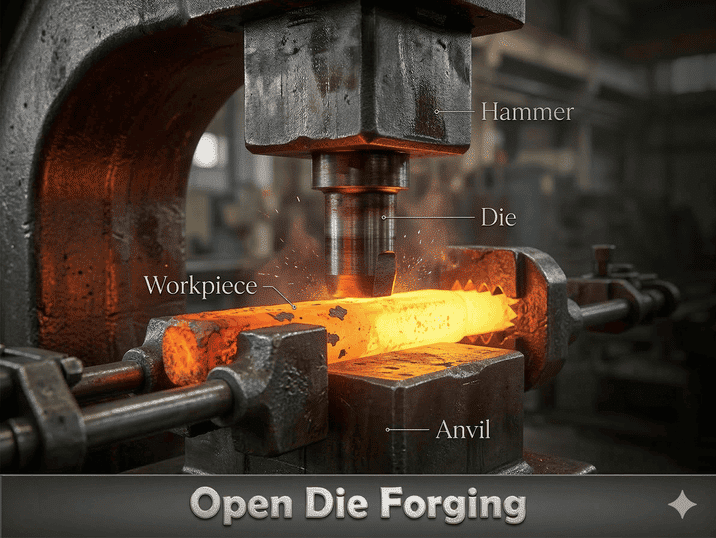
"Forging is a manufacturing process in which metal is shaped by applying compressive forces — using hammers or presses — to produce parts with superior strength, density, and structural integrity compared to cast or machined alternatives."
Renyi offers a comprehensive range of forged shapes and components, manufactured using our open-die forging hammers ranging from 350T to 1250T. By pressing and hammering metal billets under extreme pressure, we produce a refined, directional grain structure that dramatically improves mechanical performance.
Unlike casting, forging eliminates internal porosity and shrinkage defects. The result: parts that are stronger, tougher, and more fatigue-resistant — critical for applications in oil & gas, automotive, marine, and construction sectors.
Open-Die Forging
Closed-Die Forging
Carbon & Alloy Steel
Copper & Brass
Near-Net-Shape
In-House Tooling
Custom Sizes
From billet selection to finished, inspected component — controlled at every stage in our Ningbo facility.
Raw material bars are cut to precise weights; incoming material is verified against mill certifications
Billets are heated to forging temperature in controlled furnaces — steel to ~1200°C, brass to ~750°C
The hot billet is shaped under our 350T–1250T open-die hammers; multiple blows refine the grain structure
Annealing, normalizing, or quench-and-temper as required to achieve target mechanical properties
Secondary machining of critical dimensions, bores, and threads to tight tolerances in-house
Dimensional, visual and mechanical testing; full material certs and CMM reports provided
Forgings offer performance advantages over cast or machined parts that result directly from the high-pressure working of the metal — making them the preferred choice for safety-critical and high-cycle applications.
High Strength & Toughness During forging, metal is worked twice under tremendous pressure — first during billet extrusion, then during the forging stroke. This double working compacts the metal and produces a very dense, refined grain structure. Tensile strength is increased by up to 20%, and resistance to impact and abrasion is significantly enhanced compared to equivalent cast parts.
The dense, non-porous structure of forged metal eliminates the internal voids and shrinkage defects common in castings. This allows the designer to specify thinner sections without risk of leaks — resulting in lighter, lower-cost parts that meet pressure-tight requirements for valves, fittings, and hydraulic components.
Forgings produced in precision steel dies maintain tighter overall dimensions than sand castings. Because dimensions show minimal variation from part to part, forgings are ideal for automatic chucking and handling in downstream machining operations. Die impressions also produce sharp, precise surface features that are not economical with other forming processes.
Near-net-shape forging reduces raw material consumption and minimizes machining time compared to bar-stock machining. While unit tooling costs are higher than casting, the reduced scrap rate, superior mechanical properties, and longer service life result in a lower total lifecycle cost — particularly for medium-to-high volume applications in demanding environments.
| Material Category | Grades / Alloys | Typical Applications |
|---|---|---|
| Carbon Steel | 1020, 1035, 1045, A36 Chinese equiv: 20#, 35#, 45# |
Shafts, gears, flanges, brackets |
| Alloy Steel | 4140, 4340, 42CrMo, 40Cr | High-load structural parts, axles |
| Stainless Steel | 304, 316, 316L, 17-4PH | Marine, food, chemical industry |
| Copper | C110, C122 (DHP), C101 (OFH) | Electrical connectors, bus bars |
| Brass | C360 (free-machining), C260, C464 (Naval Brass) | Valves, fittings, marine hardware |
| Bronze | C932, C954 (Aluminum Bronze) | Bearings, bushings, pump parts |
Shot Blasting
Sand Blasting
Paint / Primer
Powder Coating
Chrome Plating
Hot-Dip Galvanized
Our open-die forging hammers cover a wide capacity range, allowing us to handle both small precision components and large structural forgings:
350T
Hammer
650T
Hammer
800T
Hammer
1000T
Hammer
1250T
Hammer
0.5 – 200
Part Weight Range (kg)
±0.5mm
Typical Forging Tolerance
±0.1mm
Post-Machining Tolerance
4–6 wks
Sample Lead Time
Renyi has established itself as a leading manufacturer of copper, brass and bronze forgings for global industrial and OEM clients. Our copper alloy forgings combine unique material properties with the structural benefits of the forging process.
Copper and brass forgings offer the design engineer a unique combination of properties that no other metal can replicate. The forging process — with its compressive working under heat and pressure — further enhances these inherent characteristics, resulting in parts with superior density and freedom from flaws.
Forming under heat and pressure in precision closed dies produces repeatable dimensional accuracy, part to part and lot to lot. An excellent, clean lustrous surface finish is standard — reducing or eliminating decorative post-processing costs.
High electrical & thermal conductivity
Superior corrosion resistance
High ductility & formability
Outstanding machinability
Excellent brazing & soldering
Superior polishing & finishing
Non-magnetic properties
Non-sparking characteristics
Hot forging produces a denser, more refined grain structure than casting — increasing tensile strength, eliminating porosity, and providing leak-tight integrity essential for pressure-rated fittings and valve bodies. Forged brass parts withstand dezincification and stress-corrosion cracking better than their cast counterparts.
| Alloy | Common Name | Key Properties | Typical Use |
|---|---|---|---|
| C360 | Free-Machining Brass | Excellent machinability | Fittings, valves, connectors |
| C260 | Cartridge Brass | High ductility, cold-workable | Nuts, bolts, hardware |
| C464 | Naval Brass | Seawater corrosion resistance | Marine fittings, shafts |
| C110 | Electrolytic Copper | Highest electrical conductivity | Bus bars, terminals, connectors |
| C122 | DHP Copper | Weldable, high conductivity | Plumbing, HVAC components |
| C932 | SAE 660 Bronze | Wear & load bearing | Bushings, bearings, pump parts |
| C954 | Aluminum Bronze | High strength, corrosion resistance | Marine, industrial bearings |
Superior surface finish, tighter dimensional tolerances, no porosity — forging requires no impregnation for pressure-tight duty.
No porosity or shrinkage; better ductility and impact strength; suitable for alloys that cannot be pressure die cast (e.g. high-copper bronzes).
Near-net-shape reduces material waste by 40–60%; grain flow follows part geometry, improving fatigue life of complex shapes.
Better mechanical properties for structural parts; more economical for medium-to-large quantities; forging handles heavier section thicknesses.